EUDR and Brazilian Timber: What Importers Need to Know
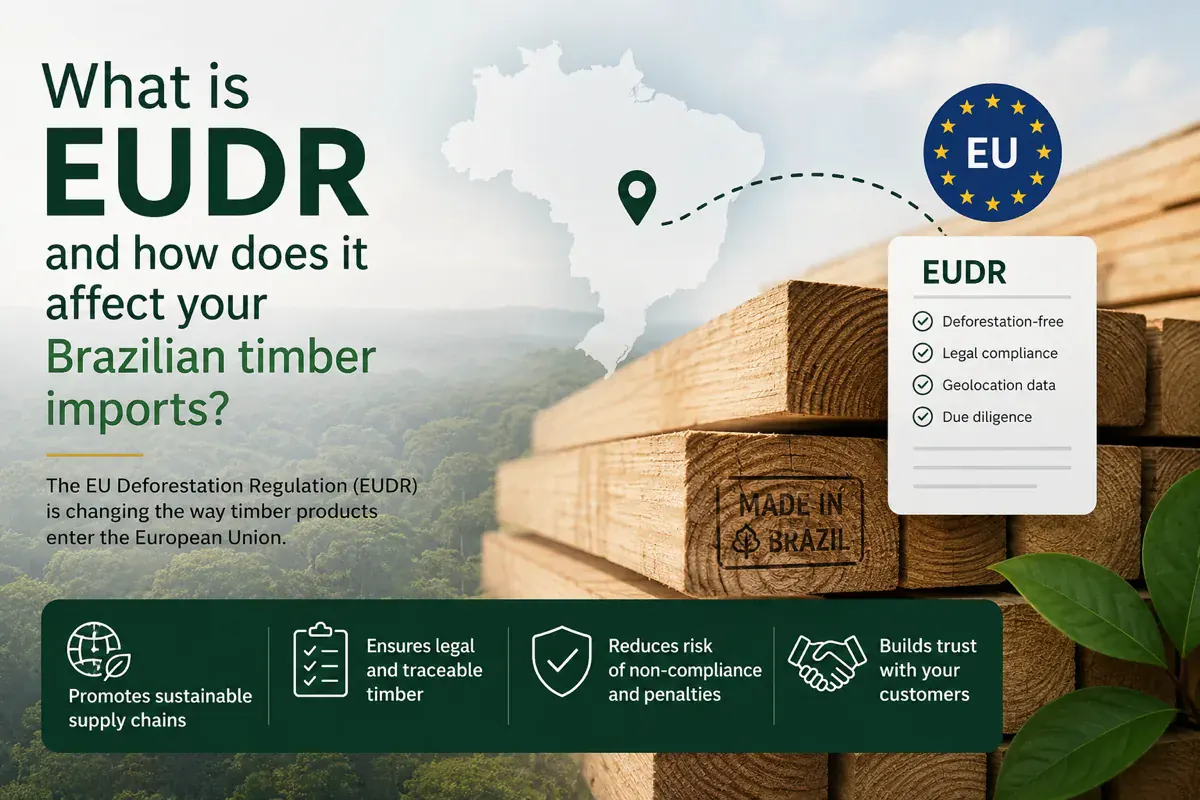
The EU Deforestation Regulation (EUDR — Regulation (EU) 2023/1115) came into force on 29 June 2023. Following the latest amendments, it applies from 30 December 2026 to large and medium operators and to micro or small operators already covered by the EU Timber Regulation. Most other micro and small operators have until 30 June 2027.
If you import timber, plywood, MDF, or furniture into the EU from any origin — including Brazil — you are an operator under EUDR. This article explains what you need to comply and how Brazilian plantation pine fits cleanly into the regulation.
What EUDR requires
EUDR replaces the EU Timber Regulation (EUTR) with stricter obligations. To place covered commodities on the EU market you must:
- Collect information — product description, country of production, geolocation of land, supplier details, and proof of legality
- Assess risk — determine whether there is a non-negligible risk of non-compliance
- Mitigate — if risk is not negligible, take additional steps before placing on market
- Submit due diligence statements — via the EU EUDR information system, before each transaction
Covered commodities include timber, sawn wood, plywood, wood-based panels, paper, and furniture — all major Brazilian wood exports.
Why Brazilian plantation pine qualifies cleanly
EUDR's "no deforestation" requirement is tied to a 31 December 2020 cut-off date. Land used to produce covered commodities must not have been subject to deforestation or forest degradation after that date.
Brazilian pine (Pinus elliottii, Pinus taeda) is grown on established plantations in Paraná and Santa Catarina — land that has been in continuous plantation forestry use for decades:
- Plantation boundaries are registered with IBAMA, Brazil's federal environmental agency
- FSC Chain of Custody certification provides documented traceability from plantation to mill
- The species are planted, not harvested from natural forest — there is no conversion of forest land involved
This means Brazilian pine plywood, MDF and solid wood panels face low practical risk under EUDR due diligence assessments.
Documents EBP provides for EUDR compliance
| Document | Issued by | What it demonstrates |
|---|---|---|
| FSC Transaction Certificate | Accredited FSC certifier | Chain of custody per shipment |
| IBAMA export licence | Brazilian federal government | Legal timber export authorisation |
| Geolocation data | EBP / mill | Plantation coordinates (polygon or point) |
| Due diligence declaration | EBP | Operator-level compliance statement |
| Phytosanitary certificate | MAPA | Pest and disease compliance |
| Certificate of Origin | Brazilian customs | Product origin documentation |
Country risk benchmark
The EU has assessed Brazil as a standard risk country under EUDR — not low risk (which simplifies obligations) but not high risk either. For plantation pine specifically, practical risk is low because the land was in forestry use before the 2020 cut-off and FSC-certified supply chains have existing documentation infrastructure.
How to verify compliance before ordering
- Request the supplier's FSC CoC certificate number and verify it at info.fsc.org
- Ask for a lot evidence due diligence statement from a previous shipment
- Confirm the supplier can provide plantation geolocation data — polygon or point coordinates
- Check that the FSC certificate explicitly covers the product category you are ordering
EUDR vs the old EU Timber Regulation (EUTR): key differences
| Aspect | Old EUTR | New EUDR |
|---|---|---|
| Scope | Timber and primary wood products | Timber + cattle, cocoa, soy, coffee, palm oil, rubber |
| Obligation | Due diligence to minimise illegal logging risk | Due diligence to ensure no deforestation after 31 Dec 2020 |
| Documentation system | No centralised system | Due diligence statements via EU information system |
| Penalties | Member state discretion | Minimum penalty of 4% of EU turnover |
| Record retention | 5 years | 5 years |
| Country risk tier | No formal tier | Low / standard / high risk classification |
The shift from "illegal logging risk" to "no deforestation" is the critical change. Under EUTR, plantation pine from Brazil was low-risk by definition (it is legal). Under EUDR, you must also demonstrate the land was not subject to deforestation after the 2020 cut-off — which for established Brazilian plantation areas is straightforward to document.
What happens at customs
EUDR due diligence statements are submitted electronically via the EU EUDR information system before the product enters the EU market — this is a pre-customs submission. The due diligence statement receives a reference number which is included in the customs declaration.
Customs authorities in member states can request access to the full documentation package at any time. Operators (importers) must be able to produce the complete file within the retention period.
For Brazilian pine, the due diligence process is typically low-friction because the documentation is well-established. The main administrative step is registering with the EU EUDR system and understanding the submission workflow before your first shipment.
Common EU importer questions
Do I need to register somewhere? Yes — operators must register with the EU EUDR information system (TRACES NT / EU EUDR portal). Registration is free.
What if my supplier already submitted a due diligence statement? If your supplier is an EU-based trader who already placed the product on the EU market, they carry the operator obligation. If you are importing directly from Brazil, you are the operator.
Does EUDR apply to furniture? Yes — furniture containing wood components (HS 94xx) is covered. A Brazilian pine furniture importer carries EUDR obligations.
Can I use EUDR documentation for multiple shipments? No — a separate due diligence statement is required for each transaction (each shipment).
Timeline reminder: key EUDR dates
- 29 June 2023 — EUDR entered into force
- 30 December 2026 — Large and medium operators, plus micro and small operators already covered by the EU Timber Regulation
- 30 June 2027 — Most other micro and small operators
- 31 December 2020 — The forest deforestation cut-off date (no deforestation after this date on land supplying covered commodities)
Products sourced from land where deforestation occurred after 31 December 2020 — regardless of species or origin — cannot be placed on the EU market. For Brazilian plantation pine, where the plantation boundaries predate this cut-off by decades, this requirement is met by default.
Related reading
EUDR-Compliant Pine Plywood from Brazil: What European Importers Must Verify · How to Verify FSC Certification · Pine Plywood
EUDR-ready timber from Brazil?
All shipments come with full geolocation documentation.
Stay informed
New guides, specs & market updates
Join 400+ timber importers who get our monthly brief — no spam, unsubscribe anytime.
Contents
Continue your sourcing research
Get a quote
Ready to source Brazilian timber? We will send specifications, pricing and photos within 24 hours.
Request a quoteRelated resources