Kiln-Dried vs Green Timber: What Importers Need to Specify
Moisture content is one of the most commonly under-specified variables when importing timber from Brazil. Importers who specify a grade and dimension but skip moisture content end up with sawn wood that warps, splits, or fails end-use performance tests after arrival.
This article explains the difference between kiln-dried and green timber, target moisture contents for different applications, and what to specify in your purchase order.
What is moisture content?
Moisture content (MC) measures the amount of water in wood relative to its dry weight, expressed as a percentage:
MC (%) = (wet weight − dry weight) / dry weight × 100
Wood is hygroscopic — it constantly gains or loses moisture to reach equilibrium with the surrounding air (called the Equilibrium Moisture Content, or EMC). The problem is that wood changes dimensions as it gains or loses moisture. This movement causes:
- Warping, bowing, and cupping in sawn timber
- Gaps in flooring and panelling
- Joint failure in furniture
- Swelling or shrinkage of door and window frames
Managing moisture content before and after shipment is essential for any precision application.
Green timber
"Green" timber is wood that has not been dried after sawing. It retains most of its original moisture — typically above 30% MC and often 50–100%+ for freshly sawn material.
When to use green timber:
- Temporary construction — scaffolding planks, site hoarding, temporary formwork
- Rough framing that will be covered and will equilibrate over time in a dry environment
- Products that will be processed further — resawn, planed, or laminated under controlled conditions before the final application
Green timber is significantly cheaper than kiln-dried. It is also heavier (higher MC = more weight = higher freight cost and lower CBM efficiency).
Caution: Never specify green timber for furniture, joinery, flooring, doors, windows, or any precision application. Movement after installation is guaranteed.
Air-dried timber
Air-dried (AD) timber has been stacked outdoors (or in open sheds) with spacers to allow air circulation. The drying process is slow and dependent on local climate — in southern Brazil, pine typically reaches 18–22% MC after 3–6 months of air drying.
Air-dried is adequate for some structural applications in humid climates, but it is not precise or fast enough for high-value joinery or furniture export.
Kiln-dried timber
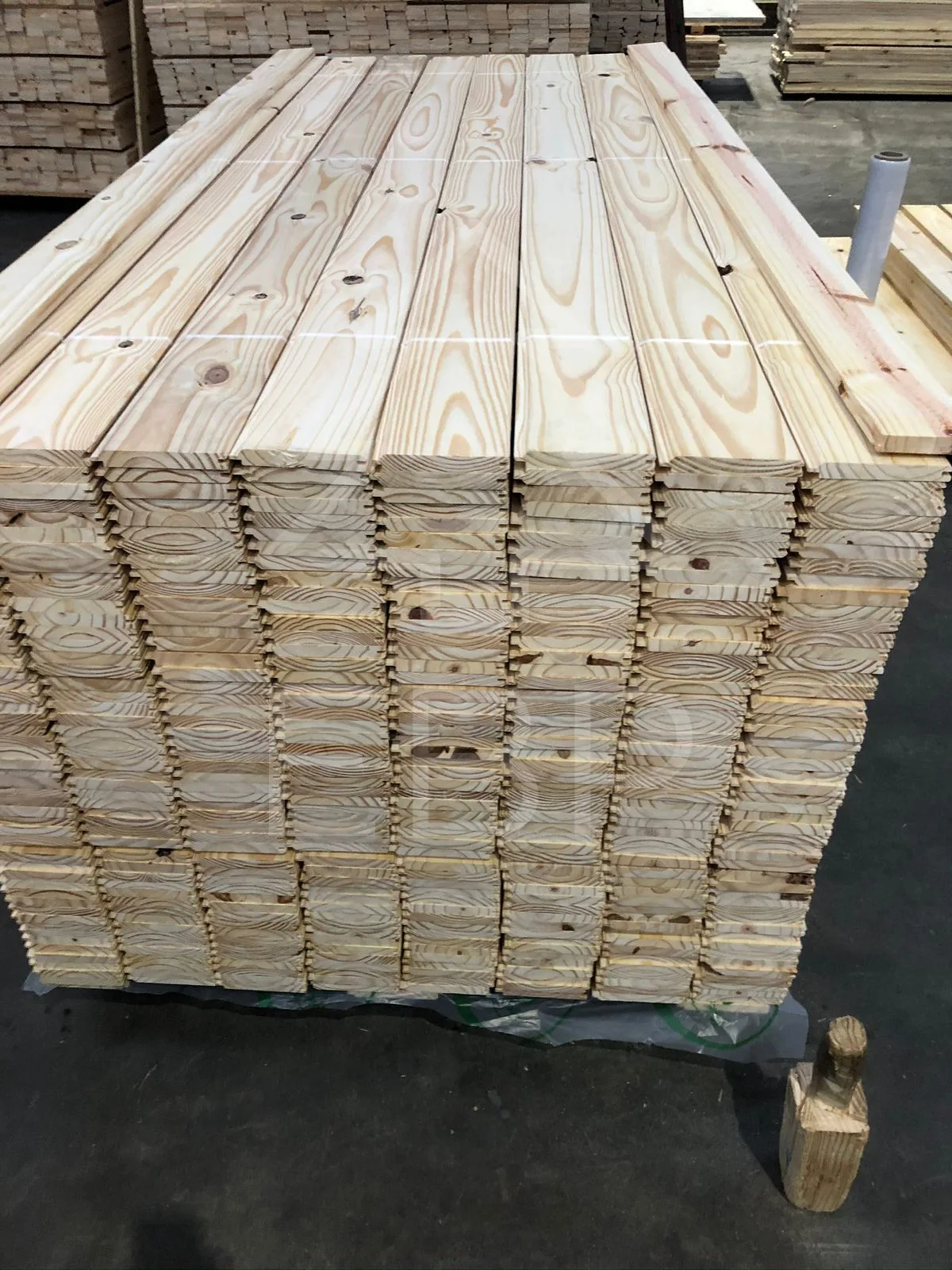
Kiln-dried (KD) timber is dried in industrial kilns under controlled temperature, humidity, and airflow conditions. The kiln program is engineered to bring the wood to a specific moisture content target within days rather than months.
Typical kiln-dried targets:
| Application | Target MC |
|---|---|
| Interior furniture and joinery | 6–10% |
| Flooring | 6–9% |
| Exterior cladding | 12–15% |
| Structural framing (covered) | 12–19% |
| Door and window frames | 10–14% |
| Plywood core veneers (before pressing) | 2–6% |
All Export Brazil Pine sawn wood is kiln-dried to customer specification. The standard export drying target is 12% ± 2% MC unless otherwise specified, which suits most European and US indoor structural and joinery applications.
Why the shipping moisture matters
Wood equilibrates to the ambient humidity of its environment. When timber kiln-dried to 8% MC in Brazil is shipped to northern Europe (ambient EMC roughly 12–16% in winter) or stored in a humid warehouse, it will absorb moisture and expand.
The converse is also true: timber dried to 15% MC and delivered to a climate-controlled German furniture factory (ambient EMC around 6–8%) will shrink and may crack.
Practical guidance:
- Match the kiln-dry target to the destination's average EMC
- For European interior joinery, specify 8–12% MC (matches central European indoor conditions)
- For US interior applications, specify 6–9% MC (US homes tend to have lower indoor humidity than Europe)
- For exterior or structural exposed to weather, specify 14–18% MC to minimise swelling on arrival
- For furniture exported to UAE and Gulf states (very low humidity), 6–9% MC is appropriate
How to specify moisture content in your purchase order
Be explicit. Do not write "kiln-dried" without a target range. A well-written specification looks like:
Pinus elliottii sawn wood, 50 × 100mm (nom), dressed four sides (D4S), kiln-dried to 10–12% MC ± 2%, measured per EN 13183-1, CE-marked per EN 14519, ISPM 15 compliant packaging.
Key elements to include:
- Target MC and acceptable range (e.g., 10–12% ± 2%)
- Measurement method (EN 13183-1 for resistance probe, or ASTM D4442 for oven-dry for US buyers)
- Point of measurement (at time of shipment, or on arrival — these differ significantly for long voyages)
- Tolerance for individual pieces (e.g., no individual piece above 16% MC)
Moisture content verification
For large orders, it is reasonable to request a moisture content report from an accredited laboratory (SGS, Bureau Veritas, or Intertek) measured at the Brazilian mill before loading. This is standard practice for furniture-grade and flooring-grade timber.
Alternatively, moisture probes can be used at arrival inspection. The key is agreeing the measurement point and tolerance in the contract before shipment, not after.
Export Brazil Pine includes mill-measured moisture content readings in the technical data sheet for all sawn wood shipments. Readings are taken by resistance probe at the mill before container loading, covering a random subsets of at least 5% of pieces per bundle. For high-value joinery and flooring orders, we can arrange third-party laboratory verification (oven-dry method per EN 13183-2) at an additional lead time of 3–5 business days.
Summary
- Green timber (>30% MC) is appropriate only for rough construction and temporary use
- Air-dried timber (18–22%) is adequate for some structural applications in humid climates
- Kiln-dried timber has a precise, application-specific MC target and is required for furniture, joinery, flooring, and doors
- Always specify the target MC range and measurement standard in your PO
- Match the drying target to the destination EMC to minimise movement after arrival
- Export Brazil Pine supplies kiln-dried sawn wood with moisture certification per shipment
Related reading
ISPM 15: The Heat Treatment Standard Every Timber Importer Needs to Know · How to Read a Timber Packing List · Sawn Wood · Pine Mouldings · Pine Doors
Need sawn timber from Brazil?
KD and green-sawn pine in custom dimensions. FCL worldwide.
Stay informed
New guides, specs & market updates
Join 400+ timber importers who get our monthly brief — no spam, unsubscribe anytime.
Contents
Continue your sourcing research
Get a quote
Ready to source Brazilian timber? We will send specifications, pricing and photos within 24 hours.
Request a quote