Pine Plywood Thickness Guide: Which to Specify
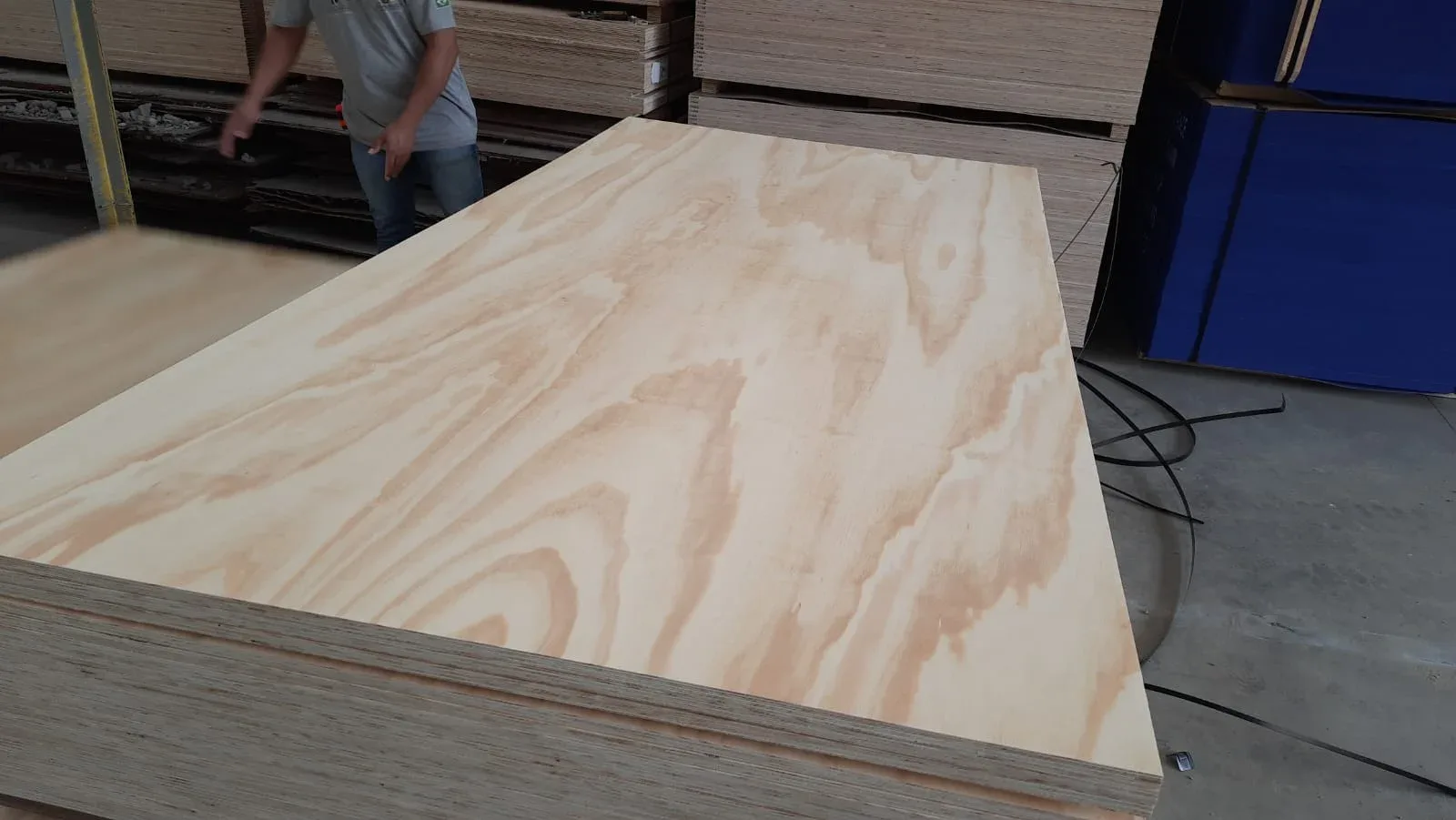
One of the most common specification questions from new timber importers is: which plywood thickness do I need? The answer depends entirely on the application — span, load, surface, and whether the panel will be visible or concealed.
This guide covers the standard thickness range for Brazilian pine plywood, typical applications for each, and what to watch for when specifying for structural use.
Standard thickness range
Brazilian pine plywood is manufactured in the following standard thicknesses:
| Thickness (mm) | Common applications |
|---|---|
| 9 | Light shelving, furniture carcase, wall panelling |
| 12 | Furniture carcase, light flooring, single-skin wall panels |
| 15 | General furniture, structural wall sheathing, sub-flooring |
| 18 | General furniture, structural sheathing, flooring underlay |
| 21 | Heavy-duty shelving, structural flooring, site hoarding |
| 24 | Structural flooring, concrete formwork |
| 25 | Heavy concrete formwork, structural flooring |
| 30 | Heavy civil formwork, industrial flooring, truck flooring |
Export Brazil Pine's standard stocked range is 9–25mm. Thicknesses outside this range are available on indent order.
9mm–12mm: furniture and light construction
The 9mm and 12mm range is the workhouse of furniture manufacturing:
- Cabinet carcases — side panels, shelves, dividers
- Furniture backs — fixed back panels for wardrobes and bookcases
- Light sub-flooring — where joist spacing is 300–400mm and live loads are low
- Single-skin wall panels — internal partition backing
For 9mm shelving, maximum unsupported span is approximately 600–800mm under typical shelf loading. Beyond that, the panel will deflect visibly.
For 12mm flooring, maximum joist spacing is typically 300mm for light residential loading. This is thin for most structural floor applications — 15mm is a safer default.
15mm–18mm: the structural range
15mm and 18mm plywood are the most versatile thickness range and account for the majority of structural and general construction use.
15mm:
- Roof sheathing (for rafter spacings up to 400mm)
- Wall sheathing (bracing panels)
- Floor underlayment under tiles or vinyl
- General furniture where a slightly lighter weight is an advantage
18mm:
- The most common thickness for furniture carcase construction worldwide
- Sub-flooring (joist spacing up to 400–450mm)
- Wall and roof sheathing
- Hoarding and site panels
- Packaging crate panels
For structural design, always verify the design values against the applicable standard (EN 12369-2 for Europe, APA or NDS for the US, AS/NZS 2269 for Australia) — do not rely on thickness alone.
Not sure which thickness fits your application? Send us a brief spec and we'll confirm the right option within 24 hours. Request a quote →
21mm–25mm: heavy structural and formwork
21mm:
- Heavy-duty industrial flooring — workshops, truck decks
- Structural sub-flooring at wider joist spacings
- Site hoarding requiring impact resistance
24mm–25mm:
- Standard film-faced formwork panels (typically 18mm or 21mm for light concrete, 25mm for heavy pours)
- Structural flooring in commercial applications
- Mezzanine decking
Film-faced (FF) panels in this range are produced with a phenolic film overlay on the face — typically 120 gsm or 220 gsm — and are designed for multiple concrete pours (typically 10–20 reuses for 120g film, up to 50 for 220g commercial grades).
30mm: heavy civil and industrial
30mm pine plywood is a specialty product primarily used in:
- Civil formwork for large pours (columns, walls, beams)
- Industrial platforms and truck body flooring
- Container floors and heavy packaging bases
At 30mm, pine plywood can span 1000–1200mm under typical floor loading. This is roughly comparable to a light hardwood flooring panel at the same thickness, though pine plywood's resistance to point loads is lower.
How to specify plywood thickness correctly
Plywood thickness is nominal. Under EN 315 (European plywood dimensional tolerances), the allowable deviation is:
- ±0.5mm for thicknesses ≤ 12mm
- ±0.8mm for thicknesses > 12mm and ≤ 25mm
- ±1.0mm for thicknesses > 25mm
This means 18mm nominal plywood can measure 17.2–18.8mm in spot checks. For applications where the actual thickness matters (e.g., fitting into a pre-routed groove), specify actual minimum thickness rather than nominal, or request calibrated sanding to a tight tolerance.
Standard sheet sizes: 1220 × 2440mm (4 × 8 ft equivalent) is the global standard from Brazilian producers. Some manufacturers also offer 1250 × 2500mm for European structural applications.
Thickness for film-faced plywood
Film-faced formwork plywood follows slightly different conventions. The face film thickness is measured in grams per square metre (gsm), not millimetres. Common film weights:
| Film weight | Reuse cycles | Application |
|---|---|---|
| 120 gsm | 8–15 | Light residential concrete |
| 200 gsm | 15–25 | Commercial concrete formwork |
| 220 gsm | 20–30 | Heavy commercial / civil |
The substrate (core plywood) thickness for film-faced is typically 15mm, 18mm, or 21mm. Heavy civil applications often use 21–25mm cores for the rigidity needed to maintain flat faces during pours.
Key takeaways
- 9–12mm: cabinet backs, light shelving and furniture panels — non-structural or lightly loaded
- 9–12mm: furniture carcases, light construction
- 15–18mm: the most versatile range — general furniture, structural sheathing, flooring
- 21–25mm: heavy structural flooring, formwork
- 30mm: civil formwork, industrial platforms
- Always specify nominal thickness and reference the applicable standard tolerance (EN 315, ANSI, or AS/NZS)
- For film-faced formwork, specify both core thickness and film weight (gsm)
Not sure which thickness to order? Use the inquiry form to describe your application and we will confirm the appropriate specification.
Related reading
CDX Plywood Specifications · B/B Grade Specifications · Film-Face Plywood Specifications · Anti-Slip Plywood Specifications · Plywood Grades Explained · WBP vs MR Plywood Bond Types · Pine Plywood
Sourcing pine plywood?
Get CDX, A/B, Film Face, and T1-11 specs + pricing in 24 h.
Stay informed
New guides, specs & market updates
Join 400+ timber importers who get our monthly brief — no spam, unsubscribe anytime.
Contents
Continue your sourcing research
Get a quote
Ready to source Brazilian timber? We will send specifications, pricing and photos within 24 hours.
Request a quoteRelated resources