CDX vs A/B vs B/B Plywood: Which Grade Should You Import?
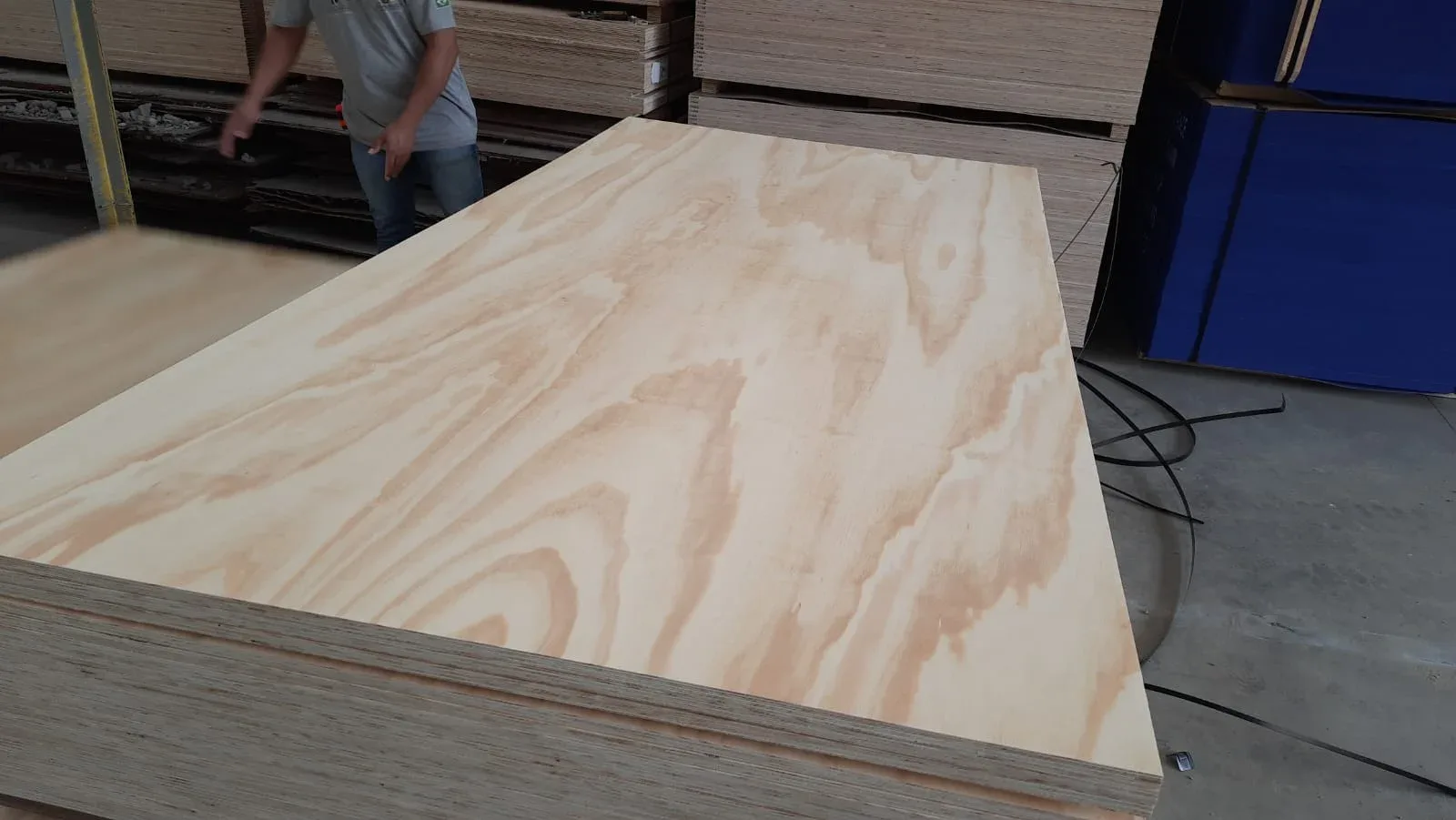
If you've ever received a plywood quote with grades like "B/B", "CDX", or "WBP film face" and weren't entirely sure what you were buying, you're not alone. The grading system is logical once you understand it — but suppliers don't always explain it, and a misspecified order can result in product that won't pass quality control or that's far more expensive than necessary for the application.
This guide explains every grade in the Brazilian pine plywood range, what the letters actually mean, and how to match grade to application.
How Plywood Grading Works
Most Brazilian pine plywood is graded with two letters — one for the face (the better side) and one for the back (the reverse side). The face and back are the two outermost veneers; the core veneers in between are typically the same species and not graded separately.
The standard grade scale from best to worst is:
| Grade | Description |
|---|---|
| A | Sanded smooth, no open defects, minimal pin knots, suitable for painting or clear coating |
| B | Sanded, some small knots and repairs allowed, still a clean surface |
| C | Unsanded or light-sanded, knots up to 40mm allowed, tight knotholes, plugs permitted |
| D | Unsanded, larger knots, splits, and open defects permitted — structural use only |
| S (Shuttering) | Same standard as D, used in concrete formwork where appearance is irrelevant |
So a panel graded A/B has an A-grade face and a B-grade back. A B/C panel has a B face and C back. The better side is always listed first.
The Main Grades — What Each One Is
CDX
CDX is the most common structural plywood grade worldwide. "C" and "D" refer to the face and back grades; "X" stands for Exterior — meaning the panel uses a WBP (Water and Boil Proof) phenolic resin glue line, making it suitable for exposure to moisture during construction, though not for permanent exterior exposure.
CDX is a workhorse product: it doesn't look good, but it performs. Typical thicknesses are 9.5mm, 12mm, 15mm, 17.5mm, and 19mm.
Best for: Roof decking, subfloor, wall sheathing, hoarding, packaging, temporary site works.
Full CDX plywood specifications and sizes →
A note on BCX and ACX: these North American grade names follow the same logic — a B or A grade show-face over a C back, with X (exterior) WBP glue. They sit a step above CDX in appearance and map directly to our B/C and A/C exterior grades. If your spec sheet calls for BCX or ACX, ask for B/C or A/C and you're describing the same product.
A/B
A/B panels have one high-quality sanded face (A-grade) and a clean sanded back (B-grade). The A face is suitable for painting, veneering, or lacquering — it's what faces the room or the customer. The B back might have minor repairs or small pin knots, but is still a presentable surface.
A/B is produced with WBP glue unless otherwise specified. Standard thicknesses run 9mm to 25mm.
Best for: Cabinet backs, furniture carcasses, wall panelling, decorative applications where one side will be visible, shopfitting.
Full A/B plywood specifications and sizes →
B/B
Both faces are sanded B-grade — small knots and repairs are acceptable on both sides. B/B is the most popular grade for furniture and interior fit-out because it gives two usable surfaces at a lower price point than A/B.
Best for: Furniture manufacturing, shelving, interior fit-out, drawer bottoms and backs, applications where both sides may be visible but paint or a finish will be applied.
Full B/B plywood specifications and sizes →
B/C
One sanded face (B) and one rough construction-quality back (C). B/C is used when only one face matters — the B side is finished, the C side is hidden or structural. Cheaper than B/B, it's a good option when you're reducing material cost without compromising the visible surface.
Best for: Flooring panels, stair treads (B side up), furniture backs fixed against a wall, structural panels with a finished face.
Full B/C plywood specifications and sizes →
A/C
An A-grade face paired with a C-grade back. Less common than B/B or B/C, but used when the front surface needs to be perfect (painting, clear finish) and the back is completely hidden — such as in fitted wardrobes, kitchen unit carcasses, or exhibition stands.
Best for: High-end painted furniture, kitchen and bathroom carcasses, built-in cabinetry, display fixtures.
Full A/C plywood specifications and sizes →
Film Face (Overlaid Plywood)
Film face plywood has a resin-impregnated film pressed onto one or both faces. The film is typically black or brown phenolic paper, though other colours are available. It creates a very hard, smooth, waterproof surface that releases cleanly from concrete.
Standard film weights are 220g/m² (single pour) and 420g/m² (multi-pour). Thicknesses typically run 12mm, 15mm, 17mm, and 18mm in standard sheet formats, and 17mm in the 1000×2000 format common in Europe and the Middle East.
Film face panels are used almost exclusively in construction. They're also referred to as shuttering plywood, formwork plywood, or concrete form plywood.
Best for: Concrete formwork and shuttering, site hoarding, marine and truck flooring (with the right film weight).
Full film-face plywood specifications and sizes →
Anti-Slip Film Face
The same construction as film face, but with a mesh or textured pattern embossed into the film surface. The mesh increases grip, making panels safer for flooring and vehicle applications.
Best for: Truck floors, trailer decking, access platforms, ramps, scaffolding boards, wet-area commercial flooring.
Full anti-slip plywood specifications and sizes →
T1-11 (Reverse Board & Batten Siding)
T1-11 is a 5/8-inch (15.5mm) exterior siding panel with vertical grooves cut into one face at either 4-inch or 8-inch spacing. The panel is designed to be installed vertically, with the grooves creating the appearance of individual boards.
It's a distinctly North American product and is the dominant exterior cladding in residential construction across the US and Canada. Brazilian manufacturers produce T1-11 to US dimensional standards (4'×8' sheets) with WBP glue and CDX-grade core.
Best for: Residential and light commercial exterior cladding, garden structures, sheds, garages.
Full T1-11 specifications and sizes →
Grade Summary Table
| Grade | Face | Back | Glue | Primary Market | Typical Use |
|---|---|---|---|---|---|
| CDX | C | D | Exterior (WBP) | USA / Global | Structural sheathing |
| A/B | A | B | WBP | Global | Furniture, cabinets |
| B/B | B | B | WBP | Global | Furniture, fit-out |
| B/C | B | C | WBP | Global | Flooring, structural facing |
| A/C | A | C | WBP | Global | High-end cabinetry |
| Film Face | — | — | WBP + film | Global | Concrete formwork |
| Anti-Slip | — | — | WBP + mesh film | Global | Transport flooring |
| T1-11 | C | D | Exterior | USA / Canada | Exterior cladding |
How to Specify Correctly
When placing a wholesale order, the grade code alone is not always sufficient. A complete specification includes:
- Grade (e.g. B/B)
- Thickness (e.g. 18mm) — nominal vs. actual can vary by ±0.5mm
- Sheet size (e.g. 1220×2440mm / 4'×8'; or 1250×2500mm for European markets)
- Glue type (WBP phenolic for structural/exterior; MR melamine for dry interior applications)
- Formaldehyde standard (E1 for Europe; CARB P2 for the USA)
- FSC certified? (adds a small premium but required by many European buyers)
- Core construction (all-pine core vs. combi-core vs. eucalyptus core — affects weight and stability)
Missing any of these often leads to substitutions or surprises at the port.
CARB P2 and Formaldehyde — What US Buyers Must Know
If you're importing plywood into the United States, CARB Phase 2 (CARB P2) compliance is effectively mandatory. California Air Resources Board P2 sets a maximum formaldehyde emission of 0.05 ppm for hardwood plywood. Major US retailers — Home Depot, Lowe's, and most regional distributors — require CARB P2 regardless of where in the US the product is sold.
Most Brazilian pine plywood mills supplying the US market are CARB P2 certified. Always confirm certification before ordering and request the TPC (Third Party Certifier) certificate with your documentation.
For Europe, the standard is E1 formaldehyde (≤ 0.124 mg/m³ air concentration), now being tightened toward E0 (≤ 0.065 mg/m³) in many markets. Brazilian mills increasingly offer E0 or "super E0" panels.
Choosing the Right Grade for Your Customer
The most common mistake importers make is over-specifying: ordering B/B when B/C would do, or A/B when B/B is sufficient. Over time, this drives unnecessary cost. Here's a quick decision framework:
- Both sides visible? → B/B or A/B
- Only one side visible, appearance matters? → A/C or B/C (B side facing out)
- Neither side visible, structural load only? → CDX
- Concrete formwork? → Film face 220g or 420g depending on pour count
- US market cladding? → T1-11 in 4'×8' with CDX grade
- US market, any interior panel? → Must be CARB P2
- European market? → E1 minimum, E0 preferred for furniture
Working with Brazilian Pine Plywood
Brazilian pine mills produce in minimum order quantities of one FCL 40'HC for stocked grades and two to four FCLs for non-standard specifications. A standard 40'HC holds approximately 600–750 sheets of 18mm B/B in 1220×2440mm format, depending on stacking density.
Lead times from order confirmation to vessel loading are typically 5–8 weeks for stocked grades and 8–12 weeks for custom specifications (non-standard dimensions, special overlays, or CARB-certified runs for smaller mills).
Related reading
WBP vs MR Plywood Bond Types · E0/E1/E2 Formaldehyde Classes Explained · Film-Faced Plywood vs MDO: Formwork Guide · Pine Plywood
Importing a specific grade? Start with the country guide for your market: United States · Canada · European Union · United Kingdom
Ready to Order?
Export Brazil Pine sources plywood from certified mills in Paraná, Santa Catarina, and Rio Grande do Sul. We can supply any grade in the range above — single FCL or multi-container programs — with full documentation including mill certificates, phytosanitary, bill of lading, and CARB P2 or FSC certificates where required.
Explore grades: CDX · A/B · B/B · B/C · A/C · Film Face · Anti-Slip · T1-11
Explore related products: Plywood · Solid Wood Panels · MDF Panels · Sawn Wood
Sourcing pine plywood?
Get CDX, A/B, Film Face, and T1-11 specs + pricing in 24 h.
Stay informed
New guides, specs & market updates
Join 400+ timber importers who get our monthly brief — no spam, unsubscribe anytime.
Contents
Continue your sourcing research
Get a quote
Ready to source Brazilian timber? We will send specifications, pricing and photos within 24 hours.
Request a quoteRelated resources