EUDR: Brazil Is Standard Risk — What Buyers Need to Know
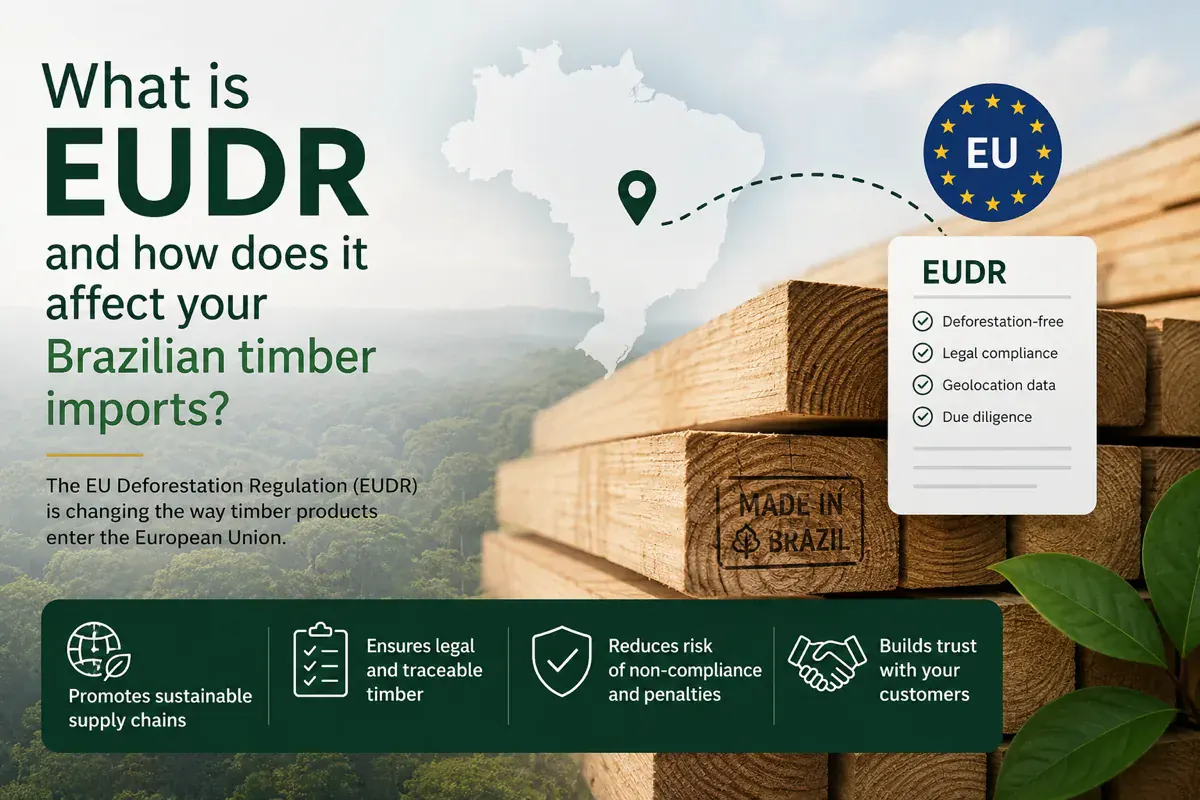
Brazil has been placed in the standard-risk category in the European Union’s country benchmarking for the EU Deforestation Regulation (EUDR). That wording is easy to misread. It does not mean Brazilian wood is presumed non-compliant, and it does not give importers a simplified route. It means buyers need the full due-diligence process required for countries that are neither low nor high risk.
This practical guide explains what the classification changes for an EU plywood or timber buyer, what evidence to request from a Brazilian supplier, and how to keep a purchase moving without making promises the regulation does not allow.
The short version
- Brazil’s standard-risk status is a process category, not a quality verdict on every Brazilian shipment.
- EU operators must collect product, legality, origin and geolocation information; assess risk; mitigate any non-negligible risk; and submit a due diligence statement (DDS).
- FSC certification strengthens the evidence trail but does not replace the DDS.
- The EU importer or other operator remains legally responsible. The Brazilian exporter supports the file with accurate, shipment-specific information.
- Keep the product specification and the compliance request together from the first quotation.
What standard risk means in practice
The EUDR benchmarking system groups countries as low, standard or high risk. Low-risk countries may use simplified due diligence. Standard-risk countries follow the complete process: information collection, risk assessment, risk mitigation where necessary, and a DDS before the product is placed on the EU market. High-risk countries face enhanced scrutiny.
For a Brazilian plywood or sawn-timber order, standard risk therefore means the buyer should plan for a complete evidence package. Do not wait until the container is at the port to ask where the wood came from or which entity will submit the DDS.
The importer’s responsibility
The company that first places covered wood products on the EU market is the operator under the EUDR. In a direct import, that is normally the EU buyer. The operator must:
- Collect the product description, quantity, country of production and supplier details.
- Record the production plots or other required geolocation data.
- Check that the product was legally produced and is deforestation-free under the regulation’s cut-off date.
- Assess the risk of non-compliance and request more evidence or mitigation if risk is not negligible.
- Submit the DDS in the EU information system and retain records for the required period.
The Brazilian supplier cannot “certify away” these duties. A good supplier makes them easier by delivering consistent, traceable and legible information tied to the actual lot.
What to request from a Brazilian supplier
For plywood, MDF or sawn timber, ask for a documented package that can be matched to the commercial invoice and packing list:
| Evidence | Why it matters |
|---|---|
| Product name, HS/CN code, quantity and lot reference | Links the DDS to the shipment |
| Country and plot-level geolocation | Supports the origin and deforestation checks |
| Species and plantation information | Identifies the relevant commodity and source |
| Legal-harvest or export evidence | Supports the legality assessment |
| FSC certificate or transaction evidence, where applicable | Adds chain-of-custody support; not a substitute for EUDR |
| Invoice, packing list and origin documents | Keeps trade and compliance records aligned |
| Current-lot photos and technical specification | Helps quality teams verify that the evidence matches the product |
Ask the supplier to identify what is provided as a redacted copy, what is available under confidentiality, and what must be submitted directly by the operator. This protects commercial information without creating a documentation gap.
A buyer workflow that works
At quotation
State the product and sub-product (for example, plywood → CDX or C+/C), thickness, end use, destination EU member state and whether FSC or another claim is required. Add “EUDR evidence required” to the inquiry so the request is routed correctly from the beginning.
At specification approval
Confirm the exact species, plantation or source group, HS/CN classification, sheet dimensions, quantity and packaging. If several products will share a container, they should be similar and made by the same manufacturer; confirm the combination with the supplier before booking.
Before shipment
Review the geolocation and legality evidence, check that names and quantities match the invoice, and agree who will submit the DDS. For repeat orders, retain the same reference structure so changes in a lot are easy to spot.
Before placing on the EU market
The operator completes the risk assessment, mitigates any non-negligible risk, submits the DDS and stores the reference number with the customs and purchase records. The importer should verify the latest EU timetable and member-state guidance because implementation details can change.
What FSC does — and does not do
FSC chain of custody is useful because it connects material through certified organisations and provides a recognised audit trail. It can reduce the time needed to assemble evidence. However, FSC is a private certification scheme, while EUDR is an EU legal obligation. FSC does not automatically prove every EUDR data field, and it does not move responsibility away from the operator.
How Export Brazil Pine can support the file
We can align the commercial specification with supplier-side traceability evidence, current-lot documentation and the export documents available for the shipment. We can also flag missing fields early, coordinate questions with the mill and keep redacted copies for commercial confidentiality. The EU importer still reviews the evidence and submits the DDS; our role is to make the source file accurate and usable.
Buyer checklist
Before approving an EU order, confirm:
- The country-risk category is reflected in your workflow as full due diligence.
- Product, sub-product, HS/CN code and quantity are fixed.
- Geolocation and species data are available for the relevant production area.
- Legality and origin evidence match the lot and commercial documents.
- FSC claims, if used, are valid and traceable but are not treated as a DDS substitute.
- The operator, DDS owner and record-retention responsibility are clear.
- Missing or confidential fields have an agreed delivery route before the container ships.
Final takeaway
Standard risk is manageable when compliance is treated as part of sourcing rather than a last-minute customs task. Put the EUDR question in the first inquiry, ask for shipment-specific evidence, and keep the legal responsibility with the EU operator. That approach gives buyers a cleaner audit trail and gives Brazilian suppliers a clear brief to fulfil.
Ask for an EUDR-ready Brazilian plywood or timber quotation or review our EUDR documentation guide before your next order.
Related reading
Brazilian plywood for EU importers · How to verify FSC certification from Brazil · Plywood grades and specifications
EUDR-ready timber from Brazil?
All shipments come with full geolocation documentation.
Stay informed
New guides, specs & market updates
Join 400+ timber importers who get our monthly brief — no spam, unsubscribe anytime.
Contents
Continue your sourcing research
Get a quote
Ready to source Brazilian timber? We will send specifications, pricing and photos within 24 hours.
Request a quoteRelated resources