OSB vs Plywood: Strength, Moisture & Cost Compared
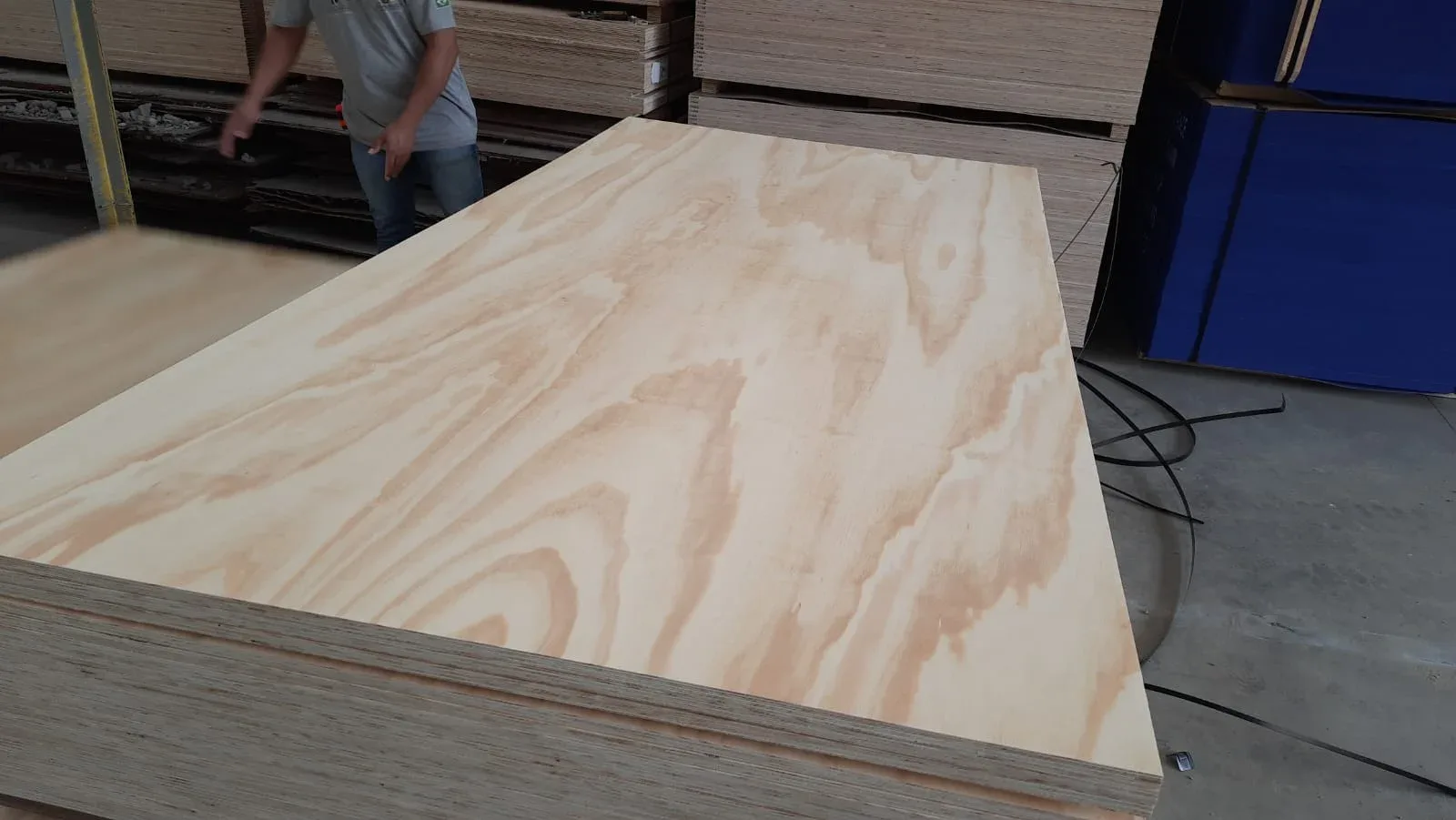
Plywood and OSB (Oriented Strand Board) compete for the same structural applications in residential and commercial construction — wall sheathing, roof decking, subfloor panels, and concrete formwork. For importers sourcing structural panels from Brazil, understanding where each product is the better specification matters for both commercial and technical reasons.
This guide covers the performance differences, standard equivalencies, and sourcing considerations for B2B buyers choosing between the two.
What is OSB?
OSB is an engineered wood panel made from strands of wood (typically softwood or mixed hardwood/softwood) oriented in layers at perpendicular angles, bonded with resin under heat and pressure. It was developed as a lower-cost alternative to structural plywood and is now the dominant structural panel in US residential construction.
OSB is graded to EN 300 (Europe) or PS2-10 (US) and classified by moisture exposure:
| Grade | Exposure class | Typical application |
|---|---|---|
| OSB/2 | Dry conditions | Interior non-structural |
| OSB/3 | Humid conditions | Load-bearing in humid environments |
| OSB/4 | Heavy-duty humid | Structural under demanding conditions |
What is pine plywood?
Brazilian pine plywood is manufactured from Pinus elliottii or Pinus taeda veneers, cross-banded at 90° and bonded under pressure. Its structural grades are:
- CDX — C-face, D-back, exterior (WBP) glue bond. The standard structural sheathing grade for the US market.
- EN 636-2 / EN 636-3 — European structural classes for humid and exterior conditions respectively. Brazilian pine with WBP bond qualifies for EN 636-3 (the highest class).
Performance comparison
| Property | Pine plywood (WBP/CDX) | OSB/3 |
|---|---|---|
| Bending strength (18mm) | Comparable — varies by grain direction | Comparable — lower perpendicular-to-strand |
| Stiffness | High in face grain direction | Moderate; lower perpendicular to strand alignment |
| Thickness tolerance | ±0.8mm (EN 315 sanded) | ±0.7–0.8mm, but more surface variation |
| Moisture resistance | WBP bond: excellent; resists boiling | OSB/3: moderate; swells at edges |
| Edge swell under moisture | Minimal (bonded veneer layers) | Significant (strand swelling) |
| Screw-holding (face) | High | Moderate |
| Screw-holding (edge) | Moderate | Low (strands delaminate) |
| Surface flatness | High (sanded grades) | Moderate (textured surface) |
| Weight at 18mm | ~12–14 kg/sheet (1220×2440mm) | ~14–16 kg/sheet |
| EUDR compliance | Clean (plantation traceability) | Varies by strand origin |
Moisture resistance: the key practical difference
This is where plywood and OSB diverge most significantly in practice. WBP plywood with phenolic adhesive maintains structural integrity under boiling water test conditions (European Type I bond). OSB/3, while moisture-resistant, will show measurable edge swell when repeatedly wet and dried — a known performance issue in roofing and wall sheathing applications where temporary exposure to rain during construction is inevitable.
For applications where moisture exposure is a realistic risk:
- Roof decking during construction before waterproofing is applied
- Wall sheathing in climates with rain-driving wind
- Subfloor panels in areas prone to plumbing leaks or flooding
- Any formwork application
In these cases, pine plywood CDX or EN 636-3 is the more appropriate specification.
Where OSB is the better choice
OSB has legitimate advantages in the right application:
- Very dry interior environments — for interior partition wall sheathing in climate-controlled buildings, OSB/2 is adequate and typically lower cost
- Large panel runs where surface appearance is irrelevant — OSB does not require sanding and is faster to produce in large volumes
- Applications where the strand texture is acceptable — flooring underlay, hoarding boards, temporary structures
Anti-dumping and duty considerations
For US buyers, this is a significant factor. Chinese OSB and plywood products face anti-dumping and countervailing duty orders adding 25–183% to the import cost. Brazilian pine plywood faces no product-wide anti-dumping measure in the US or Australia. In the EU, however, most Brazilian softwood plywood has been subject to a 5.4% definitive anti-dumping duty since 15 April 2026; one named cooperating exporter received 0%.
If you are comparing origins, calculate landed cost with the current destination tariff. For the EU, verify the base TARIC duty and add the producer-specific anti-dumping rate where applicable rather than assuming 0%.
Grade and standard equivalencies
| Application | OSB specification | Pine plywood equivalent |
|---|---|---|
| US wall sheathing | OSB PS2-10 rated | CDX, PS2-10 rated (available from Brazilian mills) |
| US roof decking | OSB PS2-10 24/16 span | CDX 15/32", PS2-10 equivalent |
| EU load-bearing humid | OSB/3 EN 300 | EN 636-2 or EN 636-3 pine plywood |
| Concrete formwork | OSB/4 or film-faced OSB | Film-faced plywood, 220 gsm phenolic |
| Subfloor (EU) | T&G OSB/3 | T&G plywood 18–22mm EN 636-3 |
Cost comparison
At current FOB prices from Brazil (June 2026):
- CDX pine plywood (18mm): USD 280–340/m³ FOB Paranaguá
- OSB/3 equivalent (18mm): USD 260–320/m³ FOB (Brazil-origin)
The price gap has narrowed significantly since 2022. After factoring in duty differentials and the superior moisture performance of plywood in many applications, pine plywood CDX is often the better total-cost specification.
Sourcing pine plywood CDX from Brazil
Brazilian pine plywood CDX is one of the most commonly exported products from Paraná state. A standard FCL 40'HC holds:
- 18mm CDX (1220×2440mm): approximately 900–1,050 sheets
- 15mm CDX: approximately 1,100–1,250 sheets
- 12mm CDX: approximately 1,300–1,500 sheets
Lead time from confirmed order to vessel loading is 4–6 weeks. Transit time to US East/Gulf Coast ports is 12–18 days; to European ports 18–25 days; to Australian ports 22–30 days.
Common specification mistakes
Specifying OSB/2 in a wet application. OSB/2 is for dry, interior use only. Specifying OSB/2 for wall sheathing in a humid climate, or subfloor panels where moisture exposure is possible, leads to edge swell, delamination, and structural degradation.
Not specifying WBP on pine plywood for exterior use. "Pine plywood" alone does not guarantee WBP bond. Always specify "pine plywood, WBP bond, EN 636-3" (EU) or "CDX, exterior glue" (US) when ordering structural material for exterior or humid applications.
Assuming all structural panels are interchangeable under PS2-10. PS2-10 covers both plywood and OSB, but the performance characteristics differ. Always check whether your specification references specific product-type limitations.
Related reading
Plywood Grades Explained: CDX, A/B, B/B, Film Face · WBP vs MR Plywood Bond Types · Pine Plywood Thickness Guide · Import Duties on Plywood: USA, EU, UAE & Australia · CDX Plywood · Pine Plywood
Sourcing structural panels for a specific market? See our import guides for the United States, Canada and the European Union.
Sourcing pine plywood?
Get CDX, A/B, Film Face, and T1-11 specs + pricing in 24 h.
Stay informed
New guides, specs & market updates
Join 400+ timber importers who get our monthly brief — no spam, unsubscribe anytime.
Contents
Continue your sourcing research
Get a quote
Ready to source Brazilian timber? We will send specifications, pricing and photos within 24 hours.
Request a quoteRelated resources