WBP vs MR Plywood: What's the Difference?
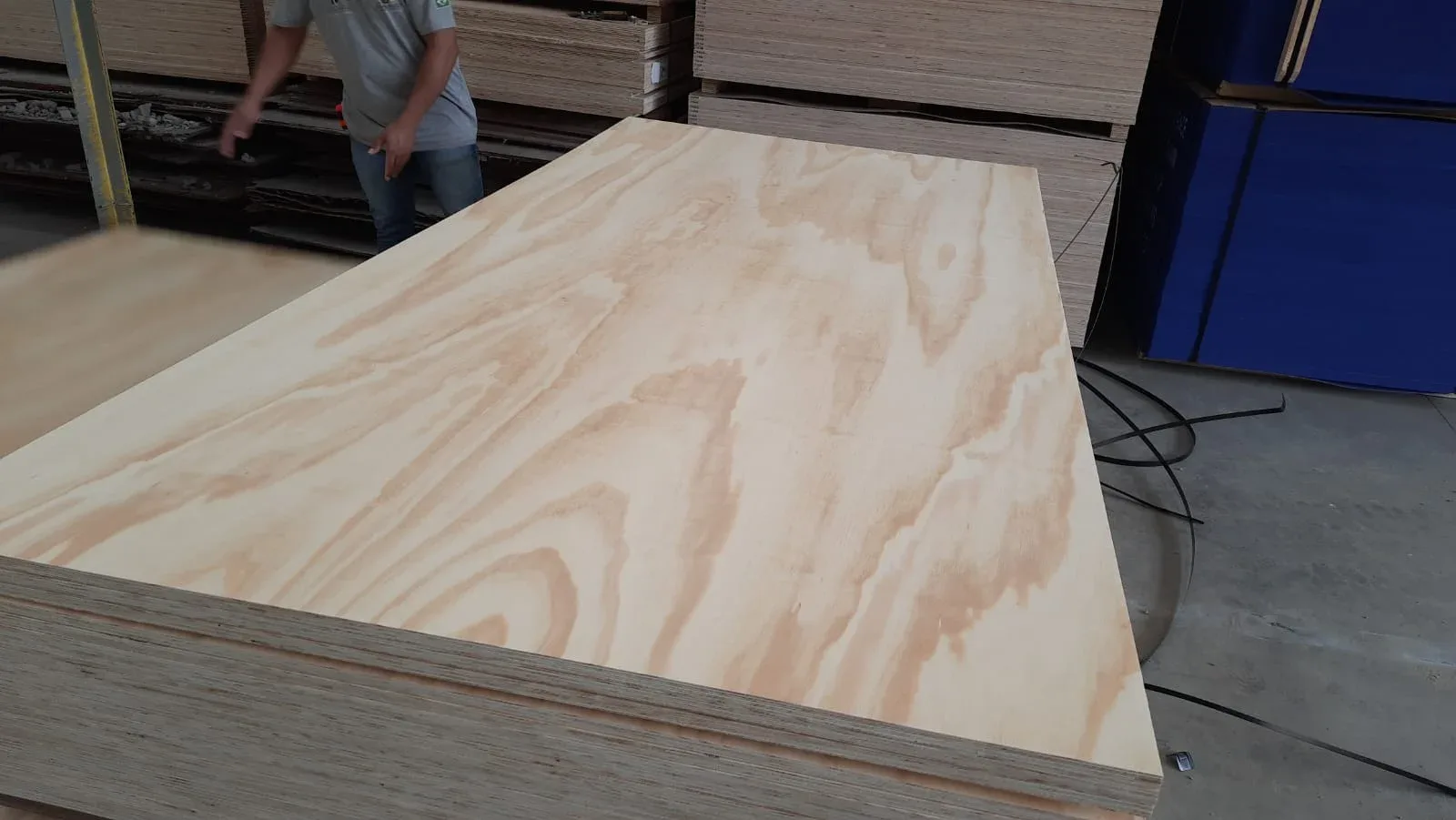
When specifying pine plywood, the glue bond is as important as the grade. Ordering B/B plywood without confirming the bond type is one of the most common and costly specification mistakes importers make.
This article explains the difference between WBP and MR bonds, when each applies, and what Export Brazil Pine supplies as standard.
WBP — Weather and Boil Proof
WBP stands for Weather and Boil Proof. It uses Phenol Formaldehyde (PF) resin — a synthetic resin that forms a permanent, waterproof bond even under prolonged moisture exposure.
Key characteristics:
- Withstands full exterior exposure and repeated wetting/drying cycles
- Passes the boiling water test (soaked in boiling water for 72 hours without delamination)
- Dark reddish-brown glue line (visible on panel edges)
- Standard for structural applications, exterior sheathing, film-faced formwork, marine applications
- Complies with EN 314-2 Class 3 (exterior)
WBP is the standard glue bond on all Export Brazil Pine plywood grades — CDX, A/B, B/B, B/C, film-faced, anti-slip, and T1-11. You do not need to specify it separately; it is the default.
MR — Moisture Resistant
MR stands for Moisture Resistant. It uses Urea Formaldehyde (UF) or Melamine-Urea Formaldehyde (MUF) resin. It resists occasional moisture exposure but is not waterproof.
Key characteristics:
- Suitable for interior applications with occasional humidity
- Not suitable for prolonged wet exposure or exterior use
- Light-coloured glue line
- Lower cost than WBP
- Complies with EN 314-2 Class 2 (humid conditions) or Class 1 (dry conditions)
MR plywood is common in furniture-grade panels where the end product will be finished and protected from moisture. It is also used in some MDF and particleboard products.
Which to specify
| Application | Recommended bond |
|---|---|
| Roof sheathing / wall sheathing | WBP |
| Concrete formwork | WBP (film-faced) |
| Exterior cladding (T1-11) | WBP |
| Marine / boat building | WBP |
| Interior furniture panels | MR or WBP |
| Flooring underlayment | WBP |
| Packaging and crating | WBP |
| Shelving (indoor, dry) | MR acceptable |
The default rule: when in doubt, specify WBP. The cost premium over MR is small; the risk of delamination in service is not.
Need WBP-bonded plywood with CARB P2 or E1 certification? We document formaldehyde compliance on every shipment. Request a quote →
Formaldehyde emissions: WBP vs MR
WBP (phenolic resin) naturally produces lower formaldehyde emissions than UF-based MR resins. This is why most CARB P2-compliant and E1-classified plywood is WBP or uses low-emission UF resins.
For export to the US (CARB P2/TSCA Title VI), EU (E1/E0.5), or other markets with emission standards, always confirm the formaldehyde class alongside the bond type.
What EBP supplies
All Brazilian pine plywood from Export Brazil Pine uses WBP Exterior Phenolic glue bond across all grades. Formaldehyde compliance (E1, CARB P2) is confirmed per order and documented on the certificate of analysis included with every shipment.
EN 314 classes: what they mean in practice
EN 314 is the European standard for plywood glue bond performance. It defines three classes by service condition:
| Class | Service condition | Resin type | Application |
|---|---|---|---|
| Class 1 | Dry interior | UF (standard MR) | Interior furniture, protected shelving |
| Class 2 | Humid interior | MUF or WBP | Kitchens, bathrooms |
| Class 3 | Exterior / exposed | PF (WBP) | Structural, formwork, exterior cladding |
All EBP plywood meets EN 314-2 Class 3 — the WBP standard. This is the requirement for CE-marked plywood under EN 636-3 (exterior conditions) and for any structural application where moisture exposure is possible.
How to verify the glue bond type
When reviewing supplier documentation:
- Test report — request the EN 314-2 Class 3 bond test from an accredited lab. A genuine WBP bond survives a boiling water cycle without delamination. Check the lab name (SGS, BV, Intertek) and that the test report references EN 314-2 Class 3.
- Declaration of Performance — CE-marked plywood with EN 636-3 classification implies WBP bond. The DoP should state EN 314-2 Class 3 under the bond performance declaration.
- Visual edge check — WBP phenolic glue shows a dark reddish-brown glue line on cut edges. UF (MR) glue lines are light cream. This is a quick site check — not a certification substitute, but useful as a first screen.
Common mistakes importers make with glue bond
Specifying grade without specifying bond. An order for "A/B 18mm plywood" without "WBP" allows the mill to substitute MR bond, which is cheaper to produce and less durable. Always include "WBP" or "phenolic bond" in your purchase order.
Confusing MR plywood with Moisture Resistant MDF. MR MDF (green core) is a different product — MDF with a moisture-resistant but not waterproof resin. The "MR" label in MDF is not the same as MR-bonded plywood. When in doubt, specify the exact product name and glue standard.
Assuming Brazilian export plywood is always WBP. Most Brazilian export plywood is WBP because international buyers require it. However, domestically-oriented mills produce MR-bonded plywood at lower cost. If your order goes through a trading house without a clear specification, you may receive the wrong bond type.
WBP, formaldehyde, and how they interact
Phenol Formaldehyde (PF) resin used in WBP bonds naturally produces lower free formaldehyde emissions than Urea Formaldehyde (UF) used in MR bonds. This is why WBP plywood commonly achieves E1 class without additional treatment.
However, WBP bond and E1 class are separate specifications. Always confirm both:
- Bond type: WBP (EN 314-2 Class 3)
- Emission class: E1 (EN 717-1 chamber method) or CARB P2 (US market)
A well-specified purchase order for EU trade: "WBP phenolic bond, E1 class, EN 636-3 applicable".
Frequently asked questions
Can WBP plywood be used for interior furniture? Yes — WBP is used in kitchen and bathroom furniture precisely because it handles moisture variation better than MR. The cost premium over MR is small.
Is film-faced formwork plywood always WBP? Yes. The phenolic film applied to film-faced plywood is itself a PF resin, and the core bond is always WBP. There is no MR-bonded film-faced formwork plywood in legitimate supply.
Does WBP certification expire? The EN 314-2 Class 3 test result is tied to a production specification, not a time period. As long as the mill's production process and adhesive remain the same, the classification holds. Annual FPC (Factory Production Control) audits maintain this under CE marking.
Related reading
CDX Plywood Specifications · B/B Grade Specifications · Film-Face Plywood Specifications · Plywood Grades Explained · CARB P2 Pine Plywood for US Importers · E0.5, E1 and E2 Formaldehyde · Pine Plywood
Sourcing pine plywood?
Get CDX, A/B, Film Face, and T1-11 specs + pricing in 24 h.
Stay informed
New guides, specs & market updates
Join 400+ timber importers who get our monthly brief — no spam, unsubscribe anytime.
Contents
Continue your sourcing research
Get a quote
Ready to source Brazilian timber? We will send specifications, pricing and photos within 24 hours.
Request a quoteRelated resources